What I’ve Learned as a Music Educator (For Real)
Collaboration has never been optional in my world.
If you’ve ever been in a rehearsal, you know this already.
Ensembles don’t work without listening. They fall apart without accountability. Growth doesn’t happen without feedback, and learning doesn’t stick without community.
When I started thinking seriously about collaborative group work in asynchronous online learning, I wasn’t questioning whether collaboration mattered. That part was obvious. The real question was:
How do we design online collaboration so it feels meaningful rather than forced?
The Real Challenge of Asynchronous Learning
Asynchronous learning can quickly feel isolating when it’s reduced to discussion posts, deadlines, and “reply to two classmates” requirements. Students technically interact, but that doesn’t mean they feel connected.
Research supports this. When social learning strategies are intentionally designed, students experience stronger engagement, deeper thinking, and a greater sense of belonging (Garrison et al., 2000; Cho et al., 2022). From a music education perspective, that makes perfect sense. Musicians learn best when they feel responsible for something bigger than themselves, such as an ensemble, a shared sound, or a common goal.
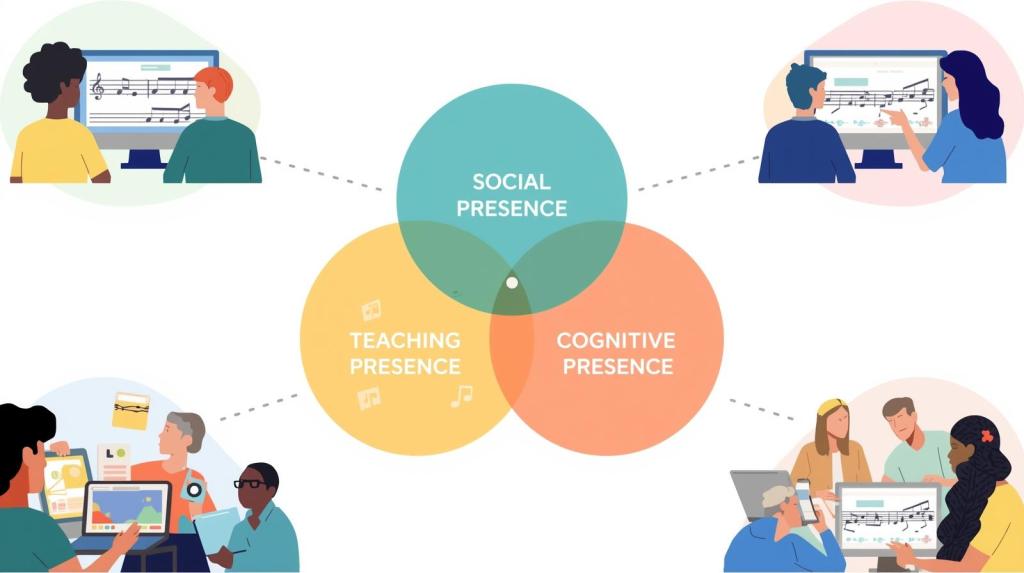
The Community of Inquiry: Why Collaboration Matters Online
The Community of Inquiry framework explains this well. It emphasizes the interaction among social presence, teaching presence, and cognitive presence as the foundation for meaningful online learning (Garrison et al., 2000).
In asynchronous environments, collaborative activities are one of the most effective ways to bring those elements to life. Below are three collaborative strategies I regularly draw from adapted specifically through a music education lens.
1. Structured Discussion Pods
(Think: Chamber Ensembles)
Instead of placing all students in a single massive discussion space, I use small, consistent discussion pods. This mirrors how chamber ensembles function in music: everyone has a role, and individual contributions matter.
Group Size: 4–5 students
How I Use This:
Students analyze a performance, genre, or rehearsal challenge while rotating roles such as:
- Musical analyst
- Expressive critique
- Connection to prior learning
Expected Outcomes:
- Deeper musical dialogue
- Stronger peer relationships
- Improved critical thinking
Potential Drawback:
There can be uneven participation if roles aren’t clearly defined or rotated.
Research shows that structured small-group collaboration supports sustained interaction and deeper inquiry, both of which are essential for meaningful asynchronous learning (Garrison et al., 2000).
2. Peer Feedback Circles
(Musicians Need Feedback)
Feedback is central to music learning, but online environments don’t automatically support effective critique. Without structure, peer feedback tends to stop at “good job” or emoji reactions.
Group Size: 3–4 students
How I Use This:
Students upload short recordings or compositions and respond to peers using guided prompts focused on:
- Tone
- Accuracy
- Expression
Expected Outcomes:
- Increased metacognition
- Stronger communication skills
- Greater empathy and musical awareness
Potential Drawback:
Feedback can remain surface-level without modeling and clear expectations
Research shows that structured peer interaction significantly improves engagement and learning in asynchronous environments (Cho et al., 2022). When expectations are clear, students move beyond validation and toward meaningful critique.
3. Collaborative Knowledge-Building Boards
(Shared Musical Thinking)
Asynchronous tools allow students to build understanding together over time instead of working in isolation. When designed well, this kind of collaboration leads to powerful collective learning.
Group Size: 4–6 students
How I Use This:
Students co-create Padlets or shared documents, analyzing:
- Musical genres
- Composers
- Musical elements across cultures
Expected Outcomes:
- Collective meaning-making
- Higher-order thinking
- A stronger learning community
Potential Drawback:
Cognitive overload can occur if tasks lack structure.
Well-designed collaborative tasks support deeper cognitive engagement when expectations and scaffolding are in place (Presley et al., 2021).
Why This Matters
When collaboration is thoughtfully designed in asynchronous environments, students don’t just learn content; they also build relationships.
They learn how to:
- Listen
- Reflect
- Respond
- Contribute meaningfully
These are the same skills they need in rehearsal, performance, and real life.
For me, effective asynchronous collaboration isn’t about replicating face-to-face instruction online. It’s about designing learning experiences that honor how musicians and humans actually learn best: together.
References (APA 7)
Cho, M. H., Kim, Y., & Choi, D. H. (2022). The role of social presence in asynchronous online learning environments. Online Learning Journal, 26(1), 123–141.
Garrison, D. R., Anderson, T., & Archer, W. (2000). Critical inquiry in a text-based environment: Computer conferencing in higher education. The Internet and Higher Education, 2(2–3), 87–105.
Presley, A., Meade, L., & Adams, J. (2021). Designing collaborative activities for asynchronous online learning. Journal of Educational Technology Systems, 49(4), 527–546.

Leave a comment