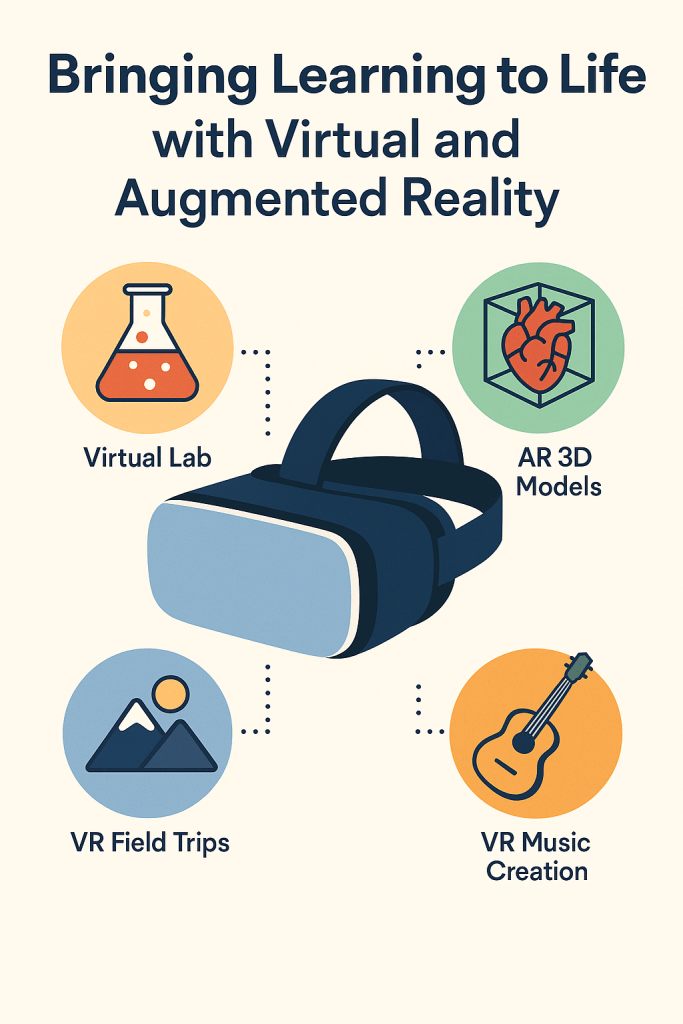
In today’s rapidly evolving educational landscape, instructional technologists and educators must stay ahead of emerging innovations. Virtual and augmented reality (VR/AR) offer powerful opportunities to transform how students learn by providing immersive, hands-on experiences not possible in traditional classrooms. At the Charise Courtney Music Studio, the integration of VR/AR into our Music Technology Lab builds upon our vision of creating an inclusive, state-of-the-art environment for creativity and collaboration. These tools not only enhance music production and performance but also broaden access for diverse learners.
For example, VR field trips can allow students to experience professional recording studios worldwide, while AR overlays can teach music theory interactively by visualizing chord structures in real time. Immersive virtual labs also give students the ability to explore complex audio engineering processes without risk or costly equipment (Radianti et al., 2020). Research highlights that VR/AR increases engagement and knowledge retention by making abstract concepts tangible and accessible (Johnson-Glenberg, 2018). For music education in particular, these tools help bridge gaps for students with different learning preferences or disabilities, ensuring that all learners can thrive in creative expression (Southgate et al., 2019).
Ultimately, implementing VR/AR in the Music Technology Lab strengthens our commitment to innovation, inclusivity, and 21st-century skill-building. By giving students the chance to compose, perform, and experiment in immersive digital environments, we create a future-focused classroom where every learner has the tools to succeed.
AR/VR Budget Add-On
To make this vision a reality, I propose an add-on investment of $14,000 that builds seamlessly on our original lab design. Here’s the breakdown:
- 5 Meta Quest 3 VR Headsets – $2,500
- 5 Apple iPad Pro 11” (AR-ready) – $5,500
- VR Software Licenses (Labster, TribeXR, SoundStage VR) – $3,000
- Instructor Management Tools – $1,000
- Furniture & Safety (VR mats, cable management) – $500
- Professional Development for Teachers – $1,500
Expanded Total Budget: $74,000 (including contingency funds)
What This Means for Students
This expansion is more than just new gadgets, it’s about creating opportunities that inspire and prepare students for the future:
- 🌍 Exploration: Students can travel virtually to the ocean floor, outer space, or inside the human body.
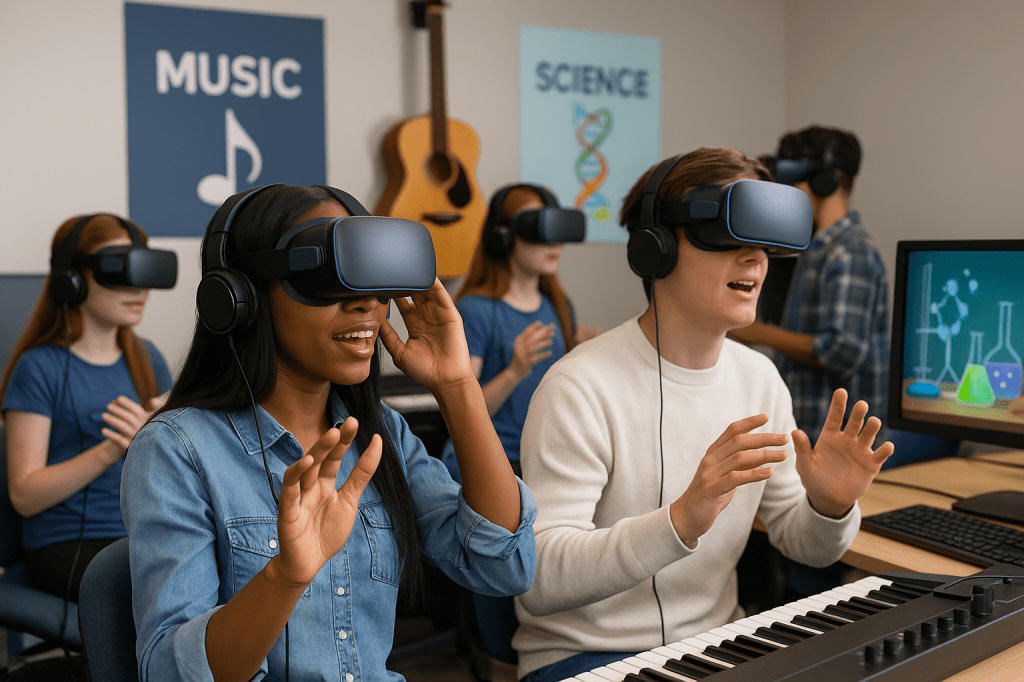
- 🎶 Creativity: Music learners can compose, mix, and perform in immersive VR studios and concert halls.
- ♿ Accessibility: AR/VR tools offer customizable learning environments that support diverse needs, from students with disabilities to those who thrive in alternative learning formats.
- 🚀 Future-Readiness: These technologies build critical 21st-century skills like digital literacy, collaboration, and creative problem-solving.
The expanded lab will serve as a model for future-ready music education, offering immersive opportunities that spark imagination, foster inclusivity, and meet the diverse needs of our learning community. I can’t wait to bring these tools to life with my students and see how they transform the way we learn and create together.
References
Johnson-Glenberg, M. C. (2018). Immersive VR and education: Embodied design principles that include gesture and hand controls. Frontiers in Robotics and AI, 5, 81. https://doi.org/10.3389/frobt.2018.00081
OpenAI. (2025). ChatGPT (May 2025 version) [Large language model]. https://chat.openai.com/
Radianti, J., Majchrzak, T. A., Fromm, J., & Wohlgenannt, I. (2020). A systematic review of immersive virtual reality applications for higher education: Design elements, lessons learned, and research agenda. Computers & Education, 147, 103778. https://doi.org/10.1016/j.compedu.2019.103778.org/10.1016/j.compedu.2019.103778
Southgate, E., Blackmore, K., Pieschl, S., Grimes, S., & Smithers, J. (2019). Embedding immersive virtual reality in classrooms: Ethical, organisational, and educational lessons in bridging research and practice. British Journal of Educational Technology, 50(3), 1229–1248. https://doi.org/10.1111/bjet.12746

Leave a comment